Chiara's Story: "The Camino Gives You What You Need."

At 5:00 AM, the air along the Camino is crisp and still. Before sunrise, pilgrims from around the globe bandage their feet, shoulder their packs, and step out into the morning to walk their daily 25 kilometers from town to town.
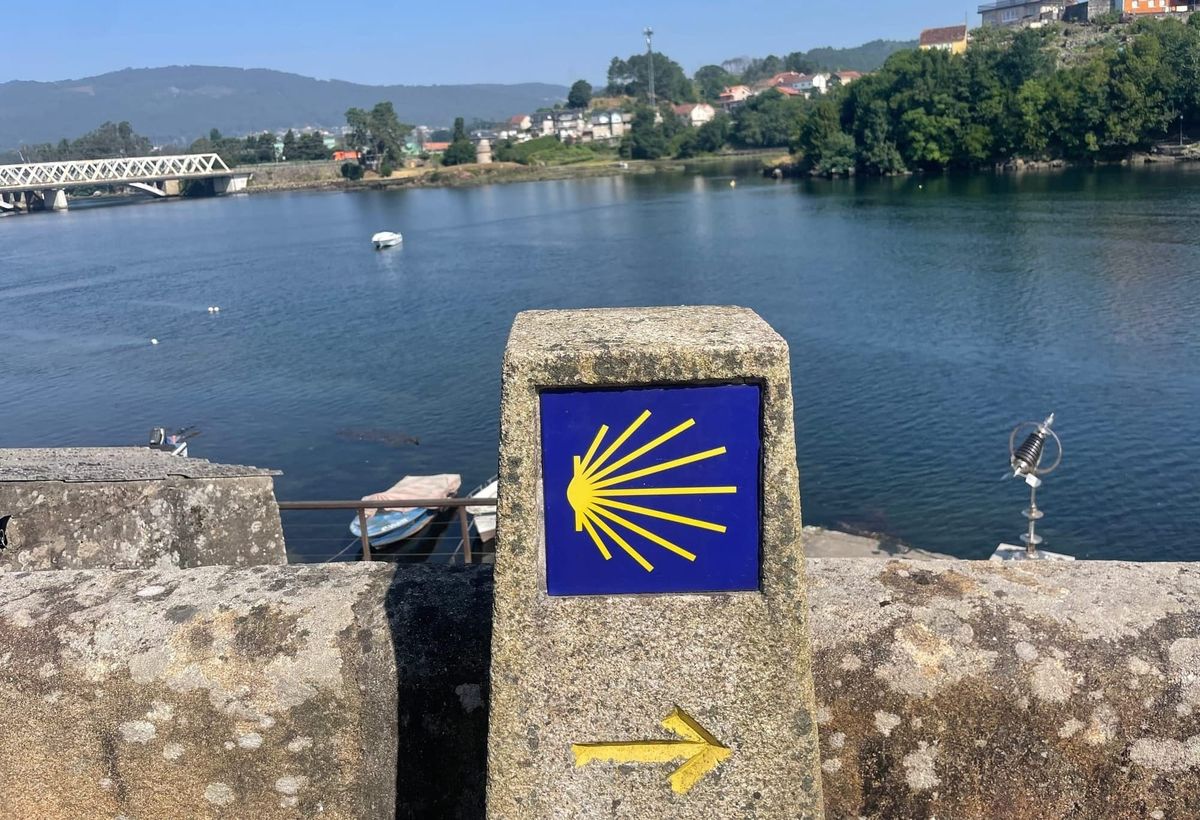
They follow the yellow scalloped shells and painted arrows fixed to trees, mossy walls, and crumbling pavement, all pointing west toward the cathedral of Santiago de Compostela in Galicia, Spain.
For years, a single word hung on the wall of Chiara’s room in Germany: “Camino”. She looked at it every day; it was a lifetime goal. One evening, the dream spilled into conversation. “Let’s just do it then,” her roommate said. Without planning, they booked flights to Portugal. Chiara was 27, unaware that walking toward Santiago would shift the trajectory of her life.
Her first trek along the Portuguese Coastal Route began with disappointment. While her friend moved through the kilometers with ease, agonizing blisters covered Chiara’s feet. Halfway through, her friend got sick and flew home. Standing alone at a crossroads with a sore body and sprained ankle, Chiara contemplated giving up too.
That was when she encountered her first "Camino magic": A fellow pilgrim from Austria. He walked alongside her, urging her to trust her strength. As her blisters turned to calluses and her backpack felt lighter, Chiara felt her mental and physical power grow stronger with each day.
“Camino magic” reveals itself along every kilometer of the walk, sometimes in the smallest moments. It’s coming across an unexpected water station right when your water pack runs dry, or meeting a stranger on a twenty-mile stretch who leaves you with a lesson you will carry forever. It’s expecting to eat alone in a Portuguese town with not a tourist in sight, only to find yourself at a table surrounded by new friends, sharing stories over a round of cervezas.
When she reached Santiago a week later, Chiara stood in the middle of the crowded square and wept from the realization of what she had accomplished. The Austrian man danced circles around her, repeating words that engraved themselves into her mind: “You are strong. You can do it.”
She returned to Germany with a transformed sense of self-confidence. “It’s powerful… Being able to do something so strong and do something for yourself.”
"In general, I don't complain as much as I did before the Camino… If I have a problem, complaining won't make it vanish. It’s a way of acceptance; of letting go of the need for control."
Back in Germany, the lessons of the trail flowed into her everyday life. Chiara quit an unhappy job and ended a long-term relationship. But at the same time, her mother fell severely ill. Chiara went on four weeks of medical leave to stay at her mother's hospital bedside.
"I was lonely. I had no friends in Cologne because everything was attached to my ex-boyfriend. I was struggling with my mom’s health… I got diagnosed with depression at the time, started therapy, and went on anti-depressants because I couldn’t handle the stress anymore."
Like many pilgrims, she felt a magnetizing pull back to the trail. Once her mother’s health stabilized, Chiara decided to walk the Camino a second time, the Portuguese Central Route, in her mother’s honor.
Passing memorials left by other pilgrims, the fragility of life hit her: “My mother could have died.”
She sat on a rock and began to cry. She realized then that she hadn't shed a single tear in an entire year. Her medication had numbed her.
"I realized I wanted to be in touch with my feelings again," she says. "So I just stopped the pills on the trail."
As her emotions came back, Camino magic began to appear again. She met a brother and sister whose mother had passed away. For the first time since her mother's illness, Chiara opened up about the fear and anger trapped inside her.
They talked about their moms for hours into the night. “[They] were the first people I talked to who could relate to that part of my life," she shares. "Nobody close to me had similar family experiences. Getting [their] perspective and seeing how they managed to work through those feelings of pain… It was such a relief."
The Camino became an unreplicable form of therapy.
"We are not able to get in touch with feelings as much as you can on the Camino. There is time... There are three basic things you need: food, a bed, and kind people to help show you the way… Walking with your feet, one step after another, you see what you’re capable of.”
The Camino's pilgrims-only hostels, albergues, operate on human trust: unlocked doors and shared communal dinners.
"There are so many different people [on the Camino]… But what's igniting them is that they want to change something, want to get in touch with themselves… I had so many conversations with such kind, warm people… You’re doing something for yourself, but you all do it together.”
By her third pilgrimage through Geira e Arrieiros, Chiara was 29 years old.
She walked slowly, intentionally breaking her habit of rushing.
"I set boundaries for the first time… I told other pilgrims I wanted to walk alone… I like the feeling of not needing anyone by my side. It's something completely new to me, and it started on the Camino this year."
"These past years everything was blooming... but I was in a rush all the time… and then it just stopped on the Camino… In past years, I was rushing because I was seeking connection. I still want connections, but [now] I can count on myself to be happy… This is what changed completely."
When she reached Santiago the third time, she sat on the ancient stones and gave grief all the room it needed.
"Many years ago I had a really bad relationship and I still sometimes suffer… The crying during the Camino was like leaving stones and bits and pieces of anger on the way.”
Now preparing to travel the world solo, Chiara carries the trail’s philosophy with her:
"I was told early on: The Camino gives you what you need at the exact time you need it. And it happened every time. Now I try to transfer it to real life. If things don’t work out, there is a reason for it. And maybe you don't know the reason at the very moment,” she shares. “My life was out of control so badly… But learning to let go helps me to calm down. To be in the moment.”
The Camino represents life. "You carry a backpack, and you might leave things behind on the Camino, but you don’t go back. You move forward with each step… We have ups and downs, as the Camino has peaks and goes down again. But every step is worth it.”